
The Short Answer
sleeping positions for back pain stiffness, increasing frequency, and pain that travels are signs your back is about to go out. Do not wait.
Walk in for a $40 evaluation. No appointment needed.
Mon-Fri 10am-7pm | Sat 10am-2pm | Brookside Tulsa
Signs your back is about to go out show up before it actually happens. Most people miss them because they are subtle and easy to explain away. Then one morning they bend down to pick something up and suddenly they cannot stand back up.
Learning to recognize the signs your back is about to go out is one of the smartest things you can do for your long term spinal health.
It was not random. The signs were there.
Table of Contents
Why Your Back Does Not Just "Go Out"
When people say their back went out, they usually mean it happened suddenly. One small movement, and everything seized up.
But that moment is almost never the actual starting point.
What really happens is that mechanical stress builds up in the spine over days, weeks, or even months. The joints get restricted. The muscles tighten around the restriction to protect it. Movement patterns shift. And eventually the system reaches its limit. The final straw breaks it.
The back going out is the end of a process, not the beginning of one.
That is why learning to recognize the signs your back is about to go out is so important. If you catch it early, you can address it before the whole thing gives out.
Warning Sign 1: Morning Stiffness That Takes Too Long to Go Away
If you wake up stiff and it takes more than 10 to 15 minutes to loosen up, that is a signal. A healthy spine moves freely from the moment you get up. Stiffness that lingers means joints are restricted and the surrounding muscles are already in a guarded state.
This is one of the earliest and most overlooked signs your back is about to go out.
Warning Sign 2: One Side of Your Lower Back Feels Tighter Than the Other
Asymmetry is a red flag. If the right side of your lower back consistently feels tighter, more tender, or more restricted than the left, one side of your pelvis or lumbar spine is not moving correctly.
That imbalance means one side is doing more nursing and back pain than it should. Over time it builds to a breaking point.
Warning Sign 3: Pain When You Transition From Sitting to Standing
If you can sit without pain, stand without pain, but the act of moving from one to the other hurts or feels unstable, that is a mechanical warning. Transitions like that require the spine to move through a range of motion where restricted joints get loaded.
Desk workers and drivers tend to notice this most. If you have to brace yourself or grab something to get up from a chair, your spine is telling you something is wrong.
Warning Sign 4: A Deep Ache That Gets Worse at the End of the Day
Surface muscle soreness from activity is normal and fades. A deeper ache that builds as the day goes on and gets harder to ignore by evening is different. That is cumulative mechanical stress reaching its limit.
If you are consistently finishing your day with a nagging low back ache that was not there in the morning, the underlying restriction is probably already present. It is just a matter of time.
Warning Sign 5: You Have Tweaked the Same Spot Before
If your back has gone out before in the same location, the probability of it happening again is high unless the underlying cause was actually addressed.
Most people rest, feel better, and return to normal activity without ever fixing the mechanical problem. The joint restriction that caused it the first time is still there. The body compensates, life goes on, and then one day it gives out again.
If you have been here before, this pattern is your most important warning sign. Read more about why back pain keeps coming back and why the cycle only stops when the cause gets addressed.
Warning Sign 6: Your Range of Motion Has Been Quietly Decreasing
If you used to be able to bend forward and touch your toes but now you cannot get past your knees, or you used to be able to rotate fully when backing out of a parking space but now you have to turn your whole body, your range of motion has been silently decreasing.
Most people do not notice gradual losses in range of motion because they happen slowly. But by the time it becomes noticeable, the restriction has usually been present for months.
According to research published through PubMed, spinal decompression and traction therapy significantly reduced pain and improved functional mobility in patients with intervertebral disc herniation, showing that addressing the underlying mechanical issue directly produces real, measurable results.
What to Do When You Notice These Signs
The worst thing you can do is wait and hope it passes.
If you are recognizing any of these signs your back is about to go out, the smartest move is to get evaluated now while it is still a restriction and not a full-blown episode. Early care is faster, less painful, and requires fewer visits than dealing with it after the whole thing goes out.
Read more about what to do when your back goes out if you are already there. And if you feel the warning signs building right now, come in before it gets to that point.
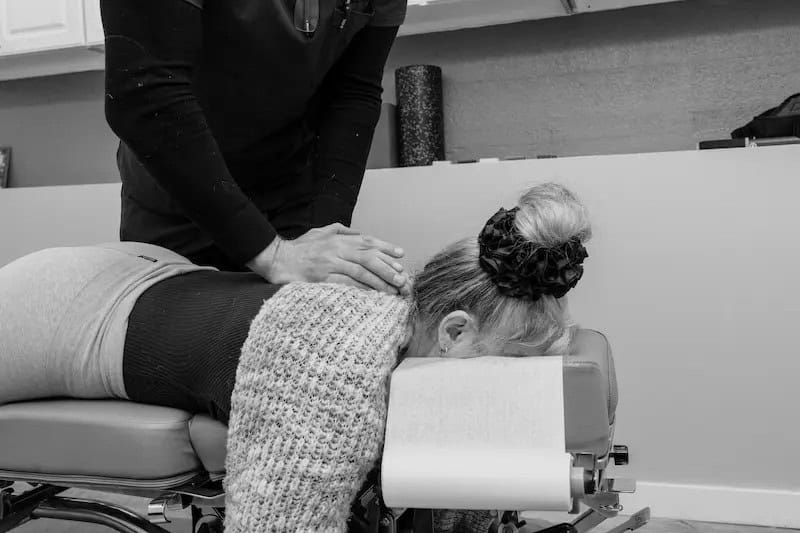
Walk In Before It Gets Worse
At Vanguard Chiropractic in Tulsa, Dr. Jason evaluates what is actually driving the restriction and addresses it directly. No appointment, no insurance, $40 flat rate.
If your body is sending you signals, listen to them. Walk in today.
Check the contact page for hours and directions or visit the FAQ page if you have questions first.
1334 E. 41st Street, Tulsa OK 74105 | 918.948.7990
Ready to Get This Fixed?
$40. Walk in. No appointment. Dr. Jason will evaluate your spine and give you a straight answer.
Call 918-948-7990Medical Disclaimer: This content is for informational purposes and does not constitute medical advice. Individual results vary. If you are experiencing severe or worsening symptoms, consult a qualified physician. This page is not intended to diagnose, treat, cure, or prevent any disease.