

By Dr. Jason Forward, DC, US Navy veteran | Vanguard Chiropractic, Brookside | Updated June 2026
When you hand over $40 for an adjustment in Tulsa, that money does not vanish. It goes somewhere specific. The question almost nobody asks is where. At a locally owned clinic, most of it stays right here in Tulsa, paying local people and circulating through local businesses. At a national chain, a real slice of it leaves the state for good, every single month. That is not an opinion or a sales line. It has been measured for two decades, and the numbers are not close.
The 60-second answer
Independent, locally owned businesses put roughly $45 of every $100 you spend back into the local economy. National chains return closer to $13 of that same $100. That is more than three times the local impact, measured across years of studies. Vanguard Chiropractic is locally owned and veteran-owned, here in Brookside. When you spend your $40 here, the large majority of it stays in Tulsa. When you spend it at a chain, a fixed cut is already promised to a corporate headquarters in another state before you ever walk in.
Where your dollar actually goes (the research)
This is called the local multiplier effect, and it is one of the most studied ideas in local economics. The research firm Civic Economics, summarized by the Institute for Local Self-Reliance, found that on average about 48% of a purchase at a local independent business recirculates in the local economy, compared with under 14% at a chain store.
Spend $100 at a locally owned business and about $45 keeps moving through your community. Spend it at a chain and about $13 stays. The rest leaves and does not come back.
The Institute for Local Self-Reliance ran its own study and landed in the same place: $100 spent at local independents generated about $45 of local activity, versus about $14 at a big-box chain, with local multipliers ranging from 3.5 times to more than 5 times depending on the community. You can read the underlying studies at the Institute for Local Self-Reliance and the American Independent Business Alliance. The same pattern holds across cities, industries, and study after study. Local ownership keeps money home. It is that simple.
A cut of every visit leaves the state, by contract
Here is the part most people do not know. National chiropractic chains are franchises. The clinic in your neighborhood is owned by a franchisee, who signs a contract agreeing to send the corporate parent a royalty on revenue, every month, for as long as the doors stay open. According to the U.S. Small Business Administration, franchise royalties commonly run 4% to 12% of gross revenue, and most franchises charge a separate marketing fee on top of that.
A franchise royalty is a permanent pipe running money out of your city to a corporate headquarters in another state. A locally owned clinic does not have that pipe.
Think about what that means over a year. A clinic that collects a few hundred thousand dollars in visits ships tens of thousands of those dollars straight out of Oklahoma, before the local owner pays themselves anything. On top of the royalty, the franchisee who actually owns the clinic often does not live in your city, so the profit they keep gets spent wherever they live. None of that is illegal or sneaky. It is just how franchising works. But it is money that, at a locally owned clinic, would have stayed in Tulsa.
Five ways your $40 stays in Tulsa at a local clinic
When the owner lives and works here, the money has nowhere to go but back into the community. Concretely:
- Local payroll. Wages go to Tulsa people who spend them at Tulsa businesses.
- Local rent. The lease check goes to a Brookside building owner, not a national real estate fund.
- Local vendors. The accountant, the sign maker, the laundry service, the supply runs, all Tulsa.
- Owner profit spent here. When the clinic does well, the owner buys groceries, gets haircuts, and eats dinner in Tulsa, not in another state.
- No royalty pipe. There is no contract sending a percentage of every visit to a corporate office somewhere else.
Your sales tax is collected locally either way. What changes with ownership is the much larger pool of profit, payroll, and spending that either circulates here or gets exported.
What locally owned means at Vanguard Chiropractic
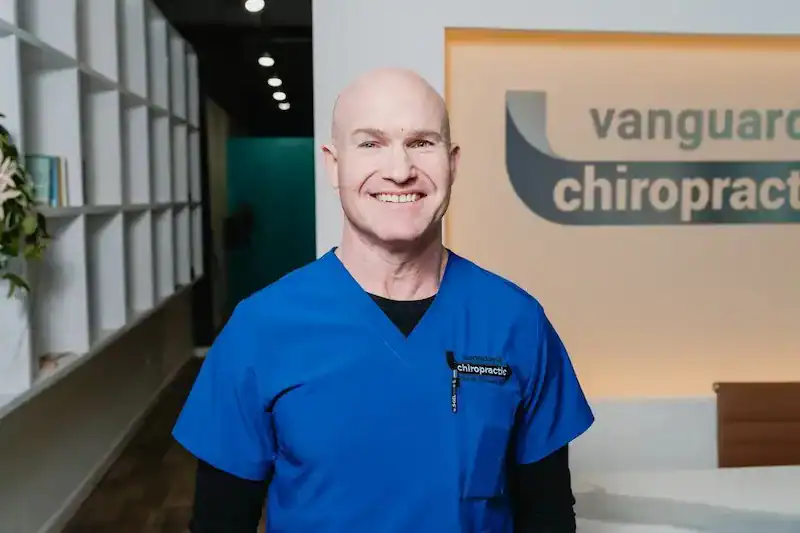
I am not a regional manager, and there is no corporate parent above me. I am the chiropractor, I am the owner, and I am a US Navy veteran. I chose to plant my flag in Brookside, on 41st Street, in the city I live in. The rent I pay goes to a Tulsa building. The people I do business with are here. The profit I earn gets spent here. There is no monthly check leaving the state with a percentage of your visit attached to it.
So when you choose Vanguard Chiropractic over a national chain, you are getting a $40 flat-rate, walk-in adjustment with no contracts and no insurance games. You are also keeping your dollars circulating in the city you live in, at roughly three times the rate a chain would. If that matters to you, it is a real reason backed by real numbers, not a bumper sticker. You can read more about the veteran-owned story behind Vanguard Chiropractic and how the walk-in model compares to a membership.
Local clinic vs national chain, side by side
| Vanguard Chiropractic | Typical national chain | |
|---|---|---|
| Ownership | Locally and veteran-owned, owner in Tulsa | Franchise, owner often out of state |
| Royalty to corporate | None | Commonly 4% to 12% of revenue, plus a marketing fee |
| Where profit goes | Stays and recirculates in Tulsa | Owner profit plus royalties leave the state |
| Price | $40 flat, every visit | Monthly membership or per-visit tiers |
| Commitment | No contract, walk in, stop any time | Often a recurring subscription |
| Local impact per $100 | About $45 stays local | About $13 stays local |
For the full cost picture, including how cash-pay compares to running it through insurance, see cash-pay vs insurance for Tulsa chiropractors and the broader guide to choosing a chiropractor in Tulsa.
The honest part
I am not going to tell you a national chain is bad or that the people working there do not care. Many of them are good clinicians, and they are local employees earning a local paycheck. A chain clinic still pays local rent, still hires local staff, and still collects local sales tax, so some money does stay here. This is not about the staff, and it is not a knock on anyone's care. It is about the ownership model and where the profit goes after you pay. If two clinics can both help your back, and one keeps three times more of your money in the city you live in, that is a fair thing to weigh. Choose the care that fits you first. If you also want your dollars to stay home, that is a real tiebreaker, and it points one direction.
Frequently asked questions
Is a national chiropractic chain locally owned?
Usually not in the full sense. The big chains are franchises. A local franchisee owns the clinic and pays a royalty on revenue to the corporate parent, which is headquartered out of state, and that franchisee often does not live in your city. Vanguard Chiropractic is locally owned and veteran-owned, with the owner here in Tulsa.
What is a franchise royalty, and why does it matter?
It is a percentage of revenue the local clinic must send to the corporate parent every month, commonly 4% to 12% per the U.S. Small Business Administration, usually plus a marketing fee. It is money that leaves your local economy by contract. A locally owned clinic has no royalty.
How much does a chiropractic adjustment cost in Tulsa?
At Vanguard Chiropractic it is $40 flat, every visit, no insurance and no contract. Chains commonly use a monthly membership or tiered per-visit pricing. See membership vs walk-in for the breakdown.
Does shopping local really make a measurable difference?
Yes, and it has been measured. Independent businesses recirculate roughly three times more of each dollar locally than chains do, per Civic Economics and the Institute for Local Self-Reliance.
Do I have to sign up for anything to come in?
No. Walk in, pay $40, get adjusted, and stop any time. No membership, no contract. Here is what to expect on a walk-in visit in Tulsa.
How do I know chiropractic is safe?
Read the honest, evidence-based answer on whether chiropractic is safe, including how I screen before adjusting.
What does Vanguard treat?
Common complaints like back pain and neck pain. Not sure a chiropractor is the right call? Compare chiropractor vs physical therapist vs massage, or see how to find a chiropractor in Tulsa.
Keep it local. Walk in today.
Spend $40 here, and it stays here.
Walk in to Vanguard Chiropractic at 1334 E 41st St in Brookside, midtown Tulsa. Locally and veteran-owned. $40 every visit, no insurance, no contracts, stop any time.
Open Mon-Fri 10am-7pm and Sat 10am-2pm
Sources: Civic Economics, Ten Years of Studies (2012), via the Institute for Local Self-Reliance. Institute for Local Self-Reliance, Key Studies: Why Local Matters. American Independent Business Alliance, The Local Multiplier Effect. U.S. Small Business Administration, Franchise Fees. Local-economy and franchise-royalty figures describe independent businesses and franchises generally and are not specific to any one clinic. This article is for general information.