
You Have Done Everything Right.
Your Mobility Still Has Not Changed.
Working with a CrossFit mobility chiropractor in Tulsa changes what no amount of stretching can. If your squat depth, overhead position, or kipping mechanics have been stuck for months, joint restriction is the reason. Here is what is actually happening and what finally moves the needle.
The Honest Reason Your Mobility Work Is Not Sticking
As a CrossFit mobility chiropractor in Tulsa, I have been inside this sport since 2021. Started at CrossFit Hammered Steel in Hernando, Mississippi. Trained at CrossFit Roots in Colorado in 2022. Have been at CrossFit Jenks here in Tulsa since 2023. I have done the couch stretch before every squat session. I have done the 90/90. I have rolled my thoracic spine on a lacrosse ball peanut. I have done banded hip distractions. Some of it helped temporarily. A lot of it did almost nothing over a very long period.
When I started noticing the same pattern in my own training and then seeing it repeatedly in athletes who came into my office, the answer became clear. There are two completely different reasons a body cannot move through a full range of motion. One responds to stretching. The other does not.
"You cannot stretch a joint restriction. You can only stretch the tissue around it. If the joint itself is not moving, the tissue work is treating the symptom, not the source."
Tissue tightness responds to stretching, foam rolling, and soft tissue work. Joint restriction does not. A joint that is not moving freely through its full mechanical range is a structural problem. The capsule surrounding the joint, the ligaments, and the articular surfaces are all involved. No amount of pulling on the muscle that crosses that joint will restore motion to the joint itself. This is the reason athletes spend months on the same mobility drills and see almost no change. They are working on the tissue. The joint is the problem.
3 Places a CrossFit Mobility Chiropractor in Tulsa Finds Restriction First
When a CrossFit athlete comes to see a CrossFit mobility chiropractor in Tulsa, there are three joints I check before anything else. These are the most common mechanical limiters in functional fitness athletes. Every one of them responds directly to chiropractic adjustment. None of them respond adequately to stretching alone.
Why a CrossFit Mobility Chiropractor in Tulsa Is the Variable You Have Not Tried
What separates working with a CrossFit mobility chiropractor in Tulsa from working through a mobility program alone comes down to one thing. The CrossFit community has produced some of the best mobility content in the world. Kelly Starrett's work at MobilityWOD changed how coaches and athletes think about movement preparation. The Barbell Physio has produced some of the most clinically rigorous mobility programming available. GOWOD has built entire software platforms around personalized mobility protocols. This content is excellent. The athletes who use it consistently do move better than those who do not.
But there is a ceiling. If a joint is mechanically restricted, no protocol designed for tissue work will fully clear it. The tissue work helps. The stretching helps. The drills help. But the joint restriction sits underneath all of it, limiting how much the tissue work can actually accomplish. Clearing the joint restriction first and then layering mobility work on top of it is a completely different experience than mobility work alone.
This is why athletes who have worked with a CrossFit mobility chiropractor in Tulsa even once often describe the experience as: "I felt more range of motion walking out of there than I had from six months of mobility work." That is not an exaggeration. Chiropractic adjustment addresses the layer those six months of mobility work could not reach.
How a CrossFit Mobility Chiropractor in Tulsa Approaches the Assessment
When a CrossFit athlete comes into Vanguard Chiropractic for a mobility evaluation, I am not running through a checklist. I am watching how your body actually moves and identifying where the chain is breaking down.
The Overhead Squat as a Diagnostic Tool
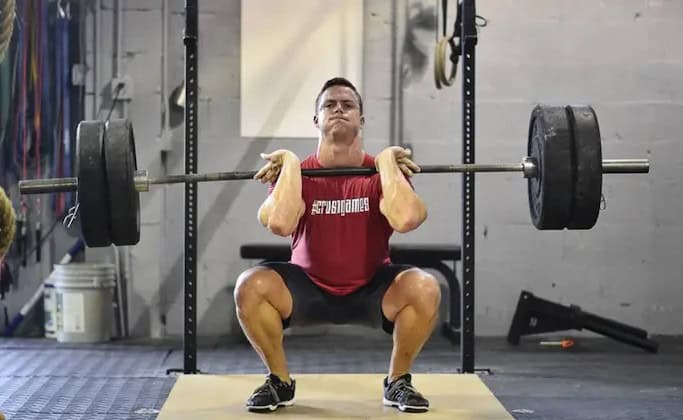
As a CrossFit mobility chiropractor in Tulsa, the overhead squat exposes more mobility restrictions simultaneously than almost any other movement. If your torso tips forward, your ankles or thoracic spine are restricting you. If your elbows bend or the bar drifts forward, your thoracic spine is almost certainly involved. If one hip dives or your knees collapse asymmetrically, the pelvis and SI joints are the first place to look. Most athletes have had coaches cue them through these faults for years. The cues do not fix the restriction. They just create temporary compensations that eventually fail under load or fatigue.
The Kipping Mechanics Check
For athletes coming to a CrossFit mobility chiropractor in Tulsa doing kipping pull-ups, butterfly pull-ups, or chest-to-bar, the arch position in the kip requires thoracic extension. When thoracic mobility is restricted, the arch collapses and the lower back overextends to compensate. Over time this is how the lumbar spine gets loaded by movements that should be loading the thoracic spine and shoulders. A thoracic adjustment in this situation frequently produces an immediately different feel in the kip arch. Athletes often notice it the same session.
The CrossFit community has excellent mobility content. What it does not have is a way to address joint restriction directly. That is what chiropractic brings to the table. It is not a replacement for mobility work. It is the thing that makes mobility work actually stick.
When You Need Both Addressed at the Same Time
A CrossFit mobility chiropractor in Tulsa sees this combination constantly. Joint restriction and tissue restriction frequently coexist. An athlete who has been compensating around a restricted joint for months develops tissue patterns that reinforce that compensation. Adjusting the joint restores the mechanical window. But if the surrounding tissue has been holding the joint in a restricted position for a long time, that tissue can pull the joint back.
This is why Nahla Forward at Stretch Haven is right down the hall from Vanguard Chiropractic at 1334 E. 41st Street in Brookside. Nahla provides Thai yoga bodywork, a form of assisted stretching and deep tissue work that addresses the tissue layer directly. For CrossFit athletes dealing with chronic thoracic stiffness, hip flexor tension, and piriformis tightness built up over training cycles, combining chiropractic adjustment with Thai yoga bodywork addresses both layers simultaneously. The adjustment restores the joint. The bodywork releases what has accumulated in the tissue around it. Both are available at the same location.
What CrossFit Athletes Notice After Seeing a CrossFit Mobility Chiropractor in Tulsa
These are not promises. Every body is different and results vary. These are simply the patterns I see most consistently as a CrossFit mobility chiropractor in Tulsa after addressing joint restriction. These are simply the patterns I see most consistently in CrossFit athletes after addressing joint restriction.
Related Pages
Your Mobility Has a Ceiling. Let's Find Out If Joint Restriction Is the Reason.
Walk in at 1334 E. 41st Street in Brookside, Tulsa. $40 flat. No appointment. No insurance required. Dr. Jason Forward DC sees every patient himself. Open Monday through Friday 10am to 7pm and Saturday 10am to 2pm.
This post is written for informational purposes and does not constitute medical advice. For more on mobility and joint function, see resources from the CrossFit Health team at CrossFit.com. If you are experiencing pain, numbness, or symptoms that are worsening, consult with a licensed healthcare provider before beginning any new training or mobility program.