
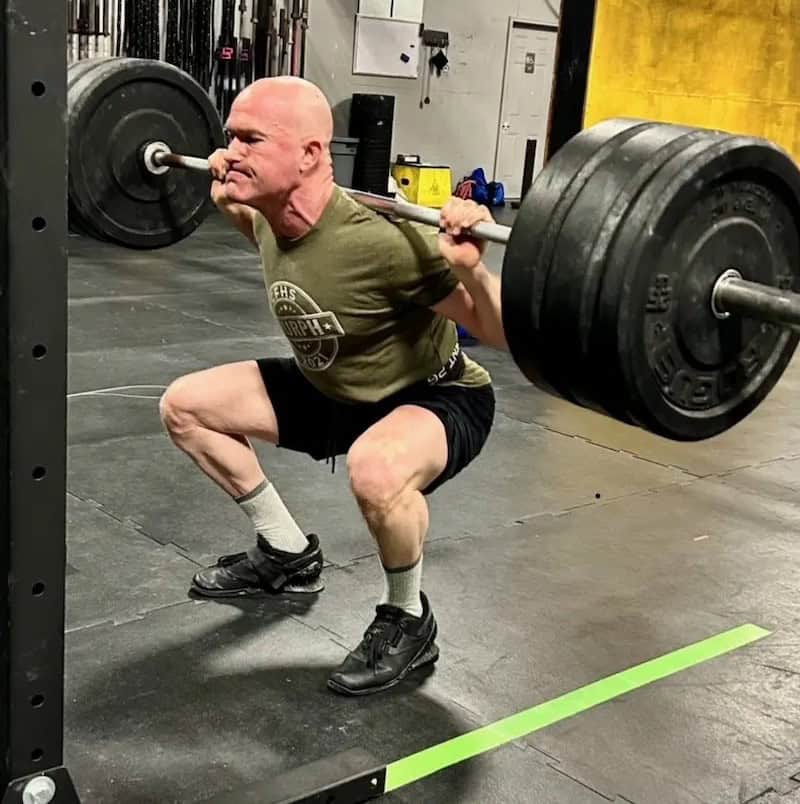
Your Hips Are the Engine.
When They Break Down, Everything Does.
Finding a hip pain chiropractor in Tulsa who actually understands CrossFit mechanics changes everything. If the anterior pinch, the SI joint ache after deadlifts, or restricted squat depth sounds familiar, you are not dealing with a flexibility problem. You are dealing with a mechanical problem. Here is what is actually happening and what fixes it.
I Know What That Hip Pinch Feels Like From the Inside
As a hip pain chiropractor in Tulsa, I work with CrossFit athletes every week who are dealing with the same problems. I started CrossFit in 2021 at CrossFit Hammered Steel in Hernando, Mississippi. Trained at CrossFit Roots in Colorado in 2022. Have been at CrossFit Jenks in Tulsa since 2023. I know what it feels like to show up for a squat cycle and hit that blocky sensation at the bottom of the hole. I know what it feels like to pull a heavy deadlift and spend the rest of the day aware of a dull ache sitting right at the back of the pelvis.
Seeing this every week as a hip pain chiropractor in Tulsa, I also know what it looks like when someone modifies their squat depth for weeks, telling themselves it will work itself out. It usually does not. Not because the hip is permanently broken, but because the thing causing the problem is still there.
As a hip pain chiropractor in Tulsa, I see CrossFit athletes who have been stretching the same hip flexor for six months with no change. They are not doing anything wrong. They are just working on the wrong problem.
"The hip pinch is not a flexibility problem. You cannot stretch your way out of a joint restriction. That is like trying to open a door by pulling on the handle when the hinge is seized."
Why the Hip Is the Most Important Joint in CrossFit
Every movement that makes CrossFit what it is runs through the hip. The squat. The deadlift. The clean. The kettlebell swing. The box jump. Power does not originate in the arms or shoulders. It originates in the posterior chain and transfers through the hip into the movement.
Triple extension, the simultaneous opening of the ankle, knee, and hip, is the mechanical signature of every explosive movement in functional fitness. If the hip is restricted, that power transfer is compromised at the source. You are not just dealing with pain. You are leaving performance on the table.
3 Problems a Hip Pain Chiropractor in Tulsa Sees in CrossFit Athletes
These are the patterns I see most often in the athletes who walk into my office. I have dealt with two of them personally. Here is the mechanical reality behind each one.
Why Rest Does Not Fix These Problems
Every CrossFit athlete has tried resting an aggravated hip. As a hip pain chiropractor in Tulsa, I have seen patients who have rested the same hip four or five times and cannot figure out why it keeps coming back. You take a week off. The pinch calms down. The SI ache fades. You come back, load the bar, and within a session or two everything is back. This is not bad luck. It is completely predictable.
Rest reduces inflammation and lets the nervous system calm the protective tension around the restricted joint. But it does not restore the mechanics that caused the problem. The moment you load the movement again, the body returns to the same compensation patterns. The restriction is still there. The asymmetry is still there. The load goes to the same places it always did.
Flare-up. Rest. Return. Repeat. That cycle is not a healing problem. It is a mechanical problem that requires mechanical intervention. Rest is not the solution. It is just a pause.
This is the pattern that eventually brings athletes into Vanguard Chiropractic. Not the first flare-up. Usually the fourth or fifth, after they have accepted that time alone is not going to change anything.
What a Hip Pain Chiropractor in Tulsa Actually Looks At
When a CrossFit athlete comes to see a hip pain chiropractor in Tulsa, I am not just looking at the hip. I am looking at the entire lumbo-pelvic complex as a connected system.
When the evaluation is complete and adjustment is appropriate, the goal is to restore normal joint motion at the specific segments that are restricted. For CrossFit athletes with hip pain, this usually involves the sacroiliac joints, the lumbar spine, and often direct hip joint mobilization. Most athletes notice a difference in how the movement feels the same visit.
This is not a long-term treatment plan. It is not a commitment to weekly visits indefinitely. Walk in, get evaluated, get adjusted if appropriate, understand what is going on and what to do next. That is the model at Vanguard Chiropractic.
Joint Work and Tissue Work Are Not the Same Thing
Joint restriction and soft tissue restriction often travel together. Adjusting the joint opens the mechanical window. But if the surrounding tissue has developed compensation patterns over months of guarded movement, that tissue can hold the joint back toward the restricted position.
For CrossFit athletes coming to a hip pain chiropractor in Tulsa dealing with hip and piriformis tension that has built up over training cycles, addressing both layers simultaneously tends to produce faster and more lasting results. Nahla Forward at Stretch Haven provides Thai yoga bodywork at the same Brookside location. Her work addresses the tissue layer in a way that complements joint restoration. The adjustment restores the mechanics. The bodywork addresses what has built up in the tissue around it. Both are available at 1334 E. 41st Street.
When to Skip This Office and Go Straight to Emergency Care
Hip pain in CrossFit athletes is almost always mechanical and appropriate for a hip pain chiropractor in Tulsa and appropriate for chiropractic evaluation. There are exceptions. If you experience any of the following, go directly to an emergency provider or your primary care physician.
- Sharp groin pain after a fall, collision, or direct impact
- Hip pain with numbness, tingling, or weakness in the lower leg or foot
- Pain severe enough that you cannot bear weight at all
- Hip pain accompanied by fever or unexplained weight loss
- Any sudden change in bowel or bladder function
If you do not have red flag symptoms, if this is the familiar anterior pinch, the SI ache after heavy pulls, the squat depth you cannot find, that is a mechanical problem. Walk in and get it evaluated.
More From Vanguard Chiropractic
Your Hips Are Limiting What You Can Do. Let's Fix That.
Walk in at 1334 E. 41st Street in Brookside, Tulsa. $40 flat. No appointment. No insurance required. Dr. Jason Forward DC sees every patient himself. Open Monday through Friday 10am to 7pm and Saturday 10am to 2pm.
This post is written for informational purposes and does not constitute medical advice. If you are experiencing severe pain, red flag symptoms, or are unsure whether chiropractic care is appropriate for your situation, consult with a licensed healthcare provider. For more information on conservative care for hip pain, see the National Institute of Neurological Disorders and Stroke.